Monday, February 3, 2025

Sourdough and civics - starter and water edition

Picture of Rowzat in her kitchen


While government has many problems, it’s important to remember the essential work it does.  In the
United States, clean water has been a public health miracle.  In this blog and accompanying video (link below), I provide tips on sourdough and highlights on the history of clean water.  This is the first video I have made for this blog.  I would love feedback on the format and content, as well as help boosting it.   

Most of you know I am a maker who bakes, upcycles, sews and crochets. I have also spent decades working in nonprofits and government (and this blog does not represent the views of my employer, by the way).

I have been making sourdough bread for more than a decade. My starter is that old too. I store the starter in the fridge between baking and when it turns a bit black and separates, it’s time to feed it. If I am not planning on baking with it soon, I will discard about 80% of the old starter of what is here, then add ¼ cup all-purpose flour, ¼ cup whole wheat flour and ¼ cup water from the tap.

Because of efforts by government, I can safely use water from the tap. My regional water utility is St. Paul Regional Water Services.  The Board of Commissioners of the utility is comprised of St. Paul City Council members and people appointed by the St. Paul mayor and city councils of suburban communities who rely on the water services. According to SPRWS website, the utility provides about 450,000 people with 40 million gallons of clean water daily.

Safe and clean drinking water is a public health miracle.  A number of government agencies have made it possible.  According to the Centers for Disease Control, Jersey City New Jersey was the first town to disinfect its drinking water in 1908.  Many other cities followed suit leading to a dramatic decline in diseases such as typhoid and cholera. According to the CDC, in 1900, there were approximately 100 cases of typhoid fever per 100,000 in the United States.  By 2006, the incidence of typhoid fever had decreased to 0.1 cases per 100,000 people (only 353 cases) and the majority of people who acquired it, acquired it while traveling internationally.

Back to my starter now. After adding the two flours and water from the tap, I mix up the starter, put the lid on the container and put it back in the fridge. I can keep it in the fridge for a week or two before I need to feed it again. 


Sunday, January 26, 2025

An exhausting and terrifying week for diversity and equity

It’s been a hard week for those who care about diversity and equity. I am scared and I am scared about even posting this blog.  But I can’t erase 30 years of my professional experience and values. We are at a critical juncture. If we don’t seek to understand what is actually happening and oppose it, people will be hurt and we will be well on the road to throwing out our democratic processes. Recently,  I have had several interactions in which people seem to be misunderstanding what the recent actions are, in addition to what DEIA is.  This post seeks to illuminate the issue.

In the past week, President Donald Trump has issued executive orders or taken other actions covering civil rights, diversity, equity, inclusion and accessibility. Some fall within his authority while others do not under our current system of government/law.

On Trump’s first day of his second term, he issued an executive order entitled, “Ending Radical and Wasteful Government DEI programs and preferences.” This order directs the “termination of all discriminatory programs, including illegal DEI and ‘diversity, equity, inclusion, and accessibility’ (DEIA) mandates, policies, programs, preferences, and activities in the Federal Government, under whatever name they appear.”   Trump has broad authority to set direction for the executive branch of the federal government, but the description of programs as illegal is questionable since programs to remedy discrimination have generally been acceptable under federal civil law for a long time.  

Unfortunately, emails have been sent to many federal workers encouraging them to report their co-workers working on DEIA, which is downright terrifying.  The Ending Radical order does not contain a mandate to nonprofits or corporations and these organizations should continue to publicly share their values supporting diversity efforts.  Laws like the Americans with Disabilities Act and related statutes that require government and other institutions to make their building and services more accessible to people with disabilities are still on the books.

Another executive order Trump issued ended affirmative action requirements for government contractors.  These requirements were established by President Lyndon Johnson in 1965 through Executive Order 11246 . In my home state of Minnesota, similar requirements are codified in state law. This represents a significant change to federal contracting. Most other remedies under federal and state civil rights laws are complaint based and this removes a tool encouraging business to take proactive steps to end discrimination. I am deeply disappointed in this, but Trump has the authority to end this program. However, non-discrimination laws like the Civil Rights Act of 1964 and the ADA still stand.

I am personally troubled by Trump’s designation of Andrea Lucas as acting head of the Equal Employment Opportunity Commission. She has voiced concern about corporate DEI programs.  But again, given the lack of changes in the law, it is still an open question as far as I am concerned about whether corporations need to end these pre-emptively. Large corporations often have the capacity and resources to handle EEOC complaints and I am disturbed that many are capitulating ahead of time.  

I have also seen major mischaracterizations of what DEIA actually is and who it benefits. It encompasses both civil rights laws and more general education and actions to make sure organizations are serving everyone.   

When I worked at the Minnesota Department of Human Rights, disability discrimination was the most common basis for complaints.  We are all a car accident or a couple decades away from a disability. When it comes to physical accessibility, ramps help our grandparents who use walkers get into libraries. They also help people without physical disabilities like parents with strollers. Likewise, anti-discrimination protections based on race strengthen those protections for people with disabilities.

When I was a diversity coordinator at another state agency, I hosted or conducted learning opportunities for all staff. I organized sessions on veterans in the workplace, issues facing rural Minnesota, understanding one’s own culture, working across cultures, treaty rights, gender, gender identity and sexual orientation, ability/disability, and religious diversity.  We also addressed systemic oppression because it is simply our country’s history.  Black and Indigenous people have had their land, labor and culture taken and we need to acknowledge that honestly.  Many other groups have also not been afforded equal rights and opportunities. Through these learning sessions, we covered issues affecting a wide range of our employees and the people we served.

When it came to hiring, I have never encouraged anyone to hire people who weren’t qualified. I’ve been a manager – it’s not in my personal interest to hire unqualified staff because that is more work for me.  However, I did encourage reflection because studies demonstrate that when researchers test resumes with similar qualifications, Black people are still at a disadvantage.  When it comes to workplace accommodations for people with disabilities, many are simple.  In my experience, accommodations often include things like stools, lighting, written instructions and bigger computer monitors. C'mon people, really we can’t offer these accommodations to make it possible for more people to work effectively?

In our country’s history, there has often been a backlash to efforts to expand rights and opportunities for the marginalized.  DEIA has basically become a bugaboo. But when you understand it more deeply, you realize that DEIA benefits society as a whole.  Losing these efforts will harm us and it’s up to us to state our values and take a stand.

p.s.

I put this on my crafting blog, because I don’t have the energy to set up a new blog right now. Please do take care of yourself during these times. Upcycling a way that I keep sane. 

Sunday, October 6, 2024

Low-waste celebration

Rowzat, cupcakes and the upcycling

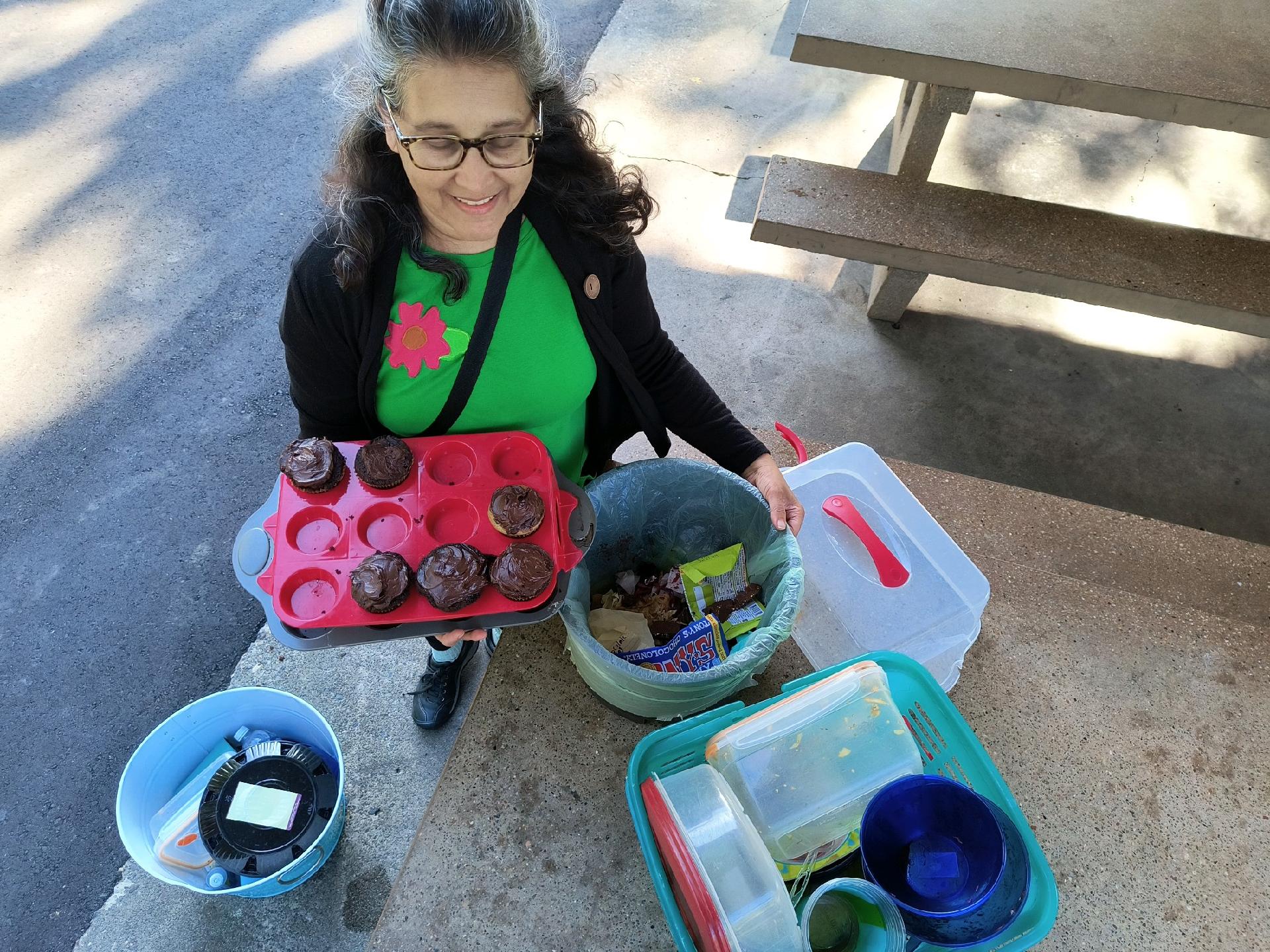
I turned 52 a few weeks ago and I threw myself a low-waste birthday picnic at a local park. We have been hosting low-waste gatherings at home, but this practice may not have been completely obvious to our guests.  I was not going to drag all the breakable dishes we use at home to a picnic site  Instead of gifts, I explicitly asked people to help me reduce single-use items by bringing a water bottle and reusable plates and dishes but that I would provide these if people weren't able to.  

I used my existing stash of sheets, scarves and tablecloths to cover the picnic tables. I purchased small gourds for decorations. We also brought all of our plastic camping and kid dishes and a tray of disposable silverware I typically wash and reuse.  

Table cloth and gourds
My neighborhood requests people bring their own dishes at neighborhood block parties so my idea was not original, but it was unfamiliar to some. People were good sports and genuinely tried to honor my birthday ask.

We labeled a paper bag for recycling and a tote for dishes and put out an unlabeled bucket with a compostable bag for organics. We did not have a good method to block off the garbage cans, which were chained down to the picnic shelter structure. t Conventional recycling mostly ended up in the right place. I fished one aluminum can out of the garbage. We had one minor disaster in which the bag blew off the table shattering one empty bottle. 

Some food waste found its way into the bucket, but more went into the garbage can. I assume people were less experienced recycling food than recycling aluminum cans. The lack of labels did not help. Organics recycling is newer in the Twin Cities and not all communities offer it. I did not fish the food out of the garbage can. 

We succeeded in directing most of the plastic packaging from ice and snacks into the bags for eventual Ridwell disposal, but we had to proactively tell people we could recycle that. 

Some guests expressed appreciation for the low-waste efforts and said more people needed to do it. Others were perplexed by the whole thing. Some brought disposable plates and we ended up with one packaged bottle of water when the event was over. One friend was super enthusiastic and brought their vegetable platter and carrot hummus in a giant metal catering container. 

I estimate saving thirty dollars by not purchasing disposable or compostable serving ware, but washing dishes after the event took time. Luckily my teenager volunteered for that job. I also had to run one load of laundry for the table coverings, but I added other clothes to the load. This article covers the inputs from washing versus using disposables. 

Friends at the party

Guests took home some of the gourds. The others are serving as fall decorations/squirrel food on my front porch. 

Friday, July 19, 2024

Doom crochet


Crochet projects with flames


We have now breached a year of 1.5 c of warning for a year, a decade before people thought it would happen.  Almost no one is talking about it. Our 80+ year-old president has COVID for the third time. Election season gets more wild by the day. And some stressful things happened at work.

I like machine sewing because I can make useful things. But it doesn't help me channel distress and anxiety. It doesn't prevent me from spending too much time online doom scrolling either. But, I have found one thing that helps me do that. Over the past several months I have taken up a new fiber art, crochet. 

Every so often for the past 30 years, I would try to teach myself to crochet and would never progress much further than making a foundation chain. But this time, I just kept working and reworking until I could crochet competently.  My biggest challenges have been random increases and decreases. To counter this, I realized I need to regularly count my stitches. I also still have problems following complex directions in patterns, but again I just committed to doing and redoing 

I like how rhythmic crochet is - it's rhythmic enough to be soothing. I also find one needle handier to transport and work with in various settings than the two needles of knitting. I have used crochet to make it easier to wait in long lines, deal with delayed flights, get through contentious meetings,  pay attention in long training and channel my worry. Now when my kid says, "I bet you were wasting time on Twitter," I can replay,  "no I was crocheting."

Doom crochet makes everything a little less painful while the world burns.

Here is a set of tutorials I like: 

\
Here are the links to the patterns I used to make the items pictured above:


Sunday, June 23, 2024

Getting started with whole grain baking

Scones on a plate

White flour is odd. It's an example of people using technology to create something, then needing more technology to solve the problems caused by the creation. White flour, also called all-purpose flour, simply lacks the complex flavor and texture of its whole-grain counterpart. 

Milling processes developed in the late 1800s stripped out the germ and bran of the wheat berry. This increased shelf life and enabled higher-rising bread. Bu According to Michael Pollan's book Cooked: A Natural History of Transfomation what was left was starch devoid of nutrition and led to people developing diseases that they had not had before they began eating refined flour.

In the 1940s, governments convinced the industry to add key nutrients back into the flour. However, as Pollan writes: "Rather than go back to address a problem at its source—the processing of key nutrients out of wheat—the industry set about processing the product even more. This was sheer brilliance: The milling industry could now sell the problem and the solution in one neat package."

Today the consumer (you and me) can't purchase great whole grain options at the store. Packaged whole-wheat bread resembles cardboard. A lot of loaves labeled multi-grain are still mostly white flour. Granola bars contain a lot of sugar. 

If you want flavorful and healthy whole-grain foods, you will likely need to make them yourself.  This post, the first in a series on whole grains, is geared toward people starting to bake with whole grains.

Quick breads are the easiest way to embark on a whole-grain journey. Quick breads are typically leavened with baking powder or baking soda plus an acid. Think banana bread, pancakes and scones.  I have come across recipes and blogs that say you can't just swap white bread for whole grain. I disagree. I do it all the time in quick breads. A good start is to swap half of the all-purpose flour for whole wheat flour. If you want a little less hearty flavor use spelt flour or white whole wheat. 

The picture at the top is a scone recipe from Martha Stewart in which I replaced the entire two cups of all-purpose flour the recipe calls for with spelt flour. I also used craisins instead of currants.  If you want to cook with recipes that begin with whole grain, I recommend the cookbook King Arthur's Whole Grain Baking

Please stay tuned for future blog posts on yeasted breads and milling your own grains.

Tuesday, June 18, 2024

Ridwell - a great service to share

Ridwell box on porch


Our family purchases minimally packaged items, composts food waste and recycles the glass, plastic and paper accepted by city recycling.  And of course, I upcycle. Despite these efforts, we are left with difficult-to-recycle items such as batteries, multi-layer plastic and electronic devices.

Manufacturers ultimately need to become responsible for the disposal of what they create. However, we are a long way from that becoming a reality and it is up to the consumer (me) to make these choices. About a year ago, I became aware of a service called Ridwell when I saw neighbors' boxes out and conversations appeared on the local zero-waste Facebook pages.  Four months ago, I signed up for Ridwell.

Ridwell offers specialty recycling in metropolitan areas such as the Twin Cities, Seattle and San Francisco. There are different options for pricing. The highest tier in my area costs $24 a month (pick up every other week) and includes multilayer plastic, styrofoam, light bulbs and batteries. Users can also select one featured item for each pickup. Metal bottle tops, cords and cables are regular options. Ridwell also offers special categories periodically. 

One of the things I realized in the first weeks of using Ridwell is that there are free local drop-off options for many of the items Ridwell accepts. Prior to signing up for Ridwell, we took plastic bags to Target, batteries to Ramsey County Hazardous Waste, e-waste to Repowered and clothing to Goodwill.  We had also been purchasing Terracycle boxes for multi-layer plastic.  For us, having those items picked up regularly has been really nice. We no longer arrive at Target and say "Darn, I forgot those bags."  For those who are more cost-conscious, the monthly fee may not warrant using Ridwell. 

Ridwell is not single sort and is best for the motivated.  Ridwell provides labeled reusable bags to place items in. My family has difficulty distinguishing between plastic film and multi-layer plastic. I have carefully read the directions. so I have less of an issue. My teenager complains about this. I retort, "Blame the manufacturers for this problem, not Ridwell."

Multilayer and plastic film bags

Another recommendation I have about Ridwell is to share. We signed up for the unlimited plan because it accepts the largest variety of items. But it is hard for only our family to fill up the bin. Two neighbors regularly drop off multi-layer plastic and styrofoam. I will also put out a call on Facebook if we have room in our featured item bags.

I also appreciate the text message reminders about pickups and their monthly dashboard. I haven't forgotten to put out my bin.

A family member who also uses Ridwell has complained that if Ridwell cancels a pickup, they still charge you, but we haven't yet experienced this.  

My verdict is Ridwell is a helpful service we will continue to use, but you can strive to be zero waste without.  

Tuesday, June 4, 2024

The rug is finally done


After more than two years, the locker hook rug project is complete! You can read more about the technique in a previous blog post.  After  locker hooking for many more hours, I finally reached the center.

I tore off the duct tape I had placed to keep the canvas edges from scratching me, folded over the canvas and whip stitched the edges.


I finished it just in time to place on my landing after a painting and carpet replacement project. I choose the turquoise accent paint color to match the rug.

This project used a lot of fabric. I lost count of how many old shirts, pants, sheets and socks went into the rug. It included old clothes from my family and thrifted items. I placed a rug pad that I found in my local Buy Nothing group under the rug to keep it from slipping.

Someday, if I decide to make another locker hook rug, I will use a more flexible canvas. I read this suggestion before I started this project and failed to heed the advice because I would have had to purchase the canvas online rather than locally. It would have been easier to pull the loops through a less stiff canvas.

As the project went in, I got better about assessing the thickness of the fabric and varying the width I cut strips. In the beginning, some strips were too thick, difficult to pull through and made my arm muscles sore. Rugs are bulky and as the project progressed I had to come up with ways to keep working on it by propping it up on pillows on the couch so I could get underneath it.

Overall, I am pleased with how it turned out and looks in my landing and relieved I have crossed this project of my list.


Sunday, March 24, 2024

Learning is struggle or mending a wool sweater

Mended blue and grey wool sweater

I see two types of sewing tutorials online. One comes from highly skilled people They make everything seem easy, but I have enough experience to know it would take me years to achieve their level of proficiency.  The other comes from people who actually do crappy work. They also make it look easy, but I have enough experience to know they are not worth emulating. By and large, no one tells you that learning these skills can be difficult. I am here to do just that. 

Last winter my spouse showed me a favorite wool sweater that had developed several holes. He wasn't sure if they had been caused by moths or wear and time. I tossed the sweater in my bin of items for mending/upcycling and it sat there for a year. 

It caught my eye when I was going through the bin intending to reduce the volume of fabric inside. The sweater was taking up a lot of room.  My spouse prefers mending not to be startlingly visible and it seemed like a good opportunity to try Swiss darning for the first time. Swiss darning is a method that duplicates the stitches in the sweater. If you use similar colors it can be relatively invisible.

Using the technique was harder than I anticipated. I struggled. I first attempted to follow the tutorial in the book Modern Mending.  I couldn't quite get it to work. I had difficulty with the geometry of the stitching and the fact that the yarn in the sweater had felted and I couldn't clearly see the stitches I needed to duplicate. Then, I went to this Youtube Video on Swiss darning and attempted their way of Swiss darning. I also checked out other online resources. Alas, none improved my technique.

Not great Swiss darning on sweater

After I had toiled away for several hours, my spouse noticed I was working on his sweater and,  said, "I didn't realize that I gave you that sweater to mend." I did manage to close a few holes, but in no instance did my mending stitches actually follow the sweater stitches in the way it was supposed to. I would probably have been better off using a woven darn, which I am more proficient at.

I couldn't use Swiss darning on some of the larger holes near the top of the sweater due to their shape and location and decided to patch them. Even though I know how to patch, this took me a few attempts. To complete these, I used my sewing machine to sew around the hole to keep it from unraveling further. I then used a zig-zag stitch to machine sew on patches cut from fleece scraps The patches puckered and looked really stupid so I undid the machine stitching and then hand-stitched the patches using a blanket stitch. 

Zig zag stitching to keep hole unraveling

After all this work, my spouse declared he felt he had to continue wearing the sweater since I had put so much time into fixing it so there was one small victory in all of this. 

I will try Swiss darning again in the future and hopefully it will go better next time.  

Sweater patching


Sunday, February 18, 2024

Upcycling to reduce an annoying night time glow

Cover for air filter's glowing controls

Some people sew and craft for artistic reasons. I have a drive to make stuff, but I want my creations to solve problems in my life. One of my recent annoyances was the glow from controls on a HEPA air purifier we purchased about a year ago. It put out enough light to be bothersome at night. 

At first, my spouse and I tried to address the problem by covering the controls with a sock. Then someone would decide to wear the sock or it would fall off and we would be back where we started. After enough of this, I decided to sew my way out of this problem. 

I found an upholstery sample from my stash that I did not have another use for.  I measured the diameter of the glowing controls on the filter.  I used a lid to create a circle pattern that was about an inch longer than the circle on the filter.  I then cut two circles from the upholstery fabric and pinned a long ribbon from my stash onto the right side of one of the circles. (I admit I originally pinned it to the incorrect side and had to redo it, but the instructions here are correct). I then stitched the circles right sides together using a 1/2 inch seam allowance and leaving about an inch opening.

Tracing a circlePinning on ribbon

I then notched the circle, turned it inside out and hand stitched the opening using a whip stitch. I then top stitched around the perimeter of the circle. 


I mentally cycled through various options to secure the ribbon to the filter.  At one point I was leaning toward using some sort of command hook. But after letting it percolate a bit, I figured out the easiest thing was to just tie the ribbon around the cord where it inserted into the machine. I applied fray check on the end of the ribbon to keep it from unraveling. 

This simple and quick project took me an hour and solved the problem. The double-layer upholstery fabric is heavy enough that it stays in place even with the air flow of the filter and does not let the light through. The fact that it is secured to the machine means that we won't lose it. My spouse was impressed with my genius, which was an added bonus. 

Ribbon tied to cord


Sunday, February 11, 2024

Quilted table cloth that stays on table


Denim table top

One of the more substantial projects I have completed in the past few years was a quilted tablecloth for our coffee table. Way back before we had a child, we left the table bare. But alas the child came along and quickly scratched and dented the table forcing us to cover it. Of course, we didn't have a coffee-table-sized cloth so we folded a sheet to fit the table and put binder clips around the edges in an attempt to keep it on the table. As you can see, that didn't work so well.  

Kid and messy coffee table and cloth

I had wanted for some time to make a quilted item with denim and had already collected old jeans from people in my local Buy Nothing group

Planning the project 

One of the main reasons to sew your own is that you can customize for your exact needs. I wanted a tablecloth that fit our table. The tablecloth needed to be thick enough to take abuse from the kid, but thin enough to balance a cup of coffee on. I also wanted the tablecloth to stay on the table, which I knew would be a challenge with my kid. 

Once I determined what I needed the tablecloth to do, I determined the size and shape of the finished project.  The table top measured 49 1/2 inches by 19 1/2 inches. I initially had planned slightly smaller, but the finished tablecloth ended up being 59 1/2  by 30 1/2 inches. 

I wanted shaping in the corners so I considered whether I would sew corner seams or add the shaping another way. I decided to sew a flat rectangle that I would gather slightly at the corner with hand sewing. 

The next step was to decide on the materials. I knew the top layer would be denim. I selected a piece of relatively unattractive upholstery fabric I had acquired as the batting or middle layer. I decided to use a duvet cover that I had purchased for $5 at a thrift shop for the bottom layer and binding. 

Piecing the denim 

Pile of cut denim piecesI  cut the seams and worn and torn areas from the many jeans I had collected. I decided that the length of my quilt blocks would simply be the width of the final quilt.  


I created both wider and narrower blocks.  For the width of the larger blocks, I laid pieces of similar size together and made blocks that varied from 6 and 8 inches, plus a 1/4 inch seam allowance on each size. I also created narrow blocks that were 2 inches plus a 1/4 inch seam allowance on each side, totaling 2 1/2 inches. 

For the wider blocks, I cut the jeans to the width and then laid the pinned pieces right sides together and, using a denim needle, stitched using a 1/4-inch seam allowance. I pressed seams open as I went. The denim was easy to work with and while it took several days, the quilt top came together more quickly than I had anticipated. 


Stitched denim piecesFeeding denim through sewing machinePressing denim pieces


Once I had several blocks, I started stitching them together  (right sides together then pressing open) with a 1/4 seam allowance). Occasionally I laid the quilt top on the table to determine if my initial size calculations were correct. In doing this, I decided to add both length and width to the quilt. 

Once I finished the quilt top, I created my sandwich with the quilt top on top, the upholstery fabric in the middle and the duvet cover on the bottom. I cut the two bottom layers bigger than the quilt top because I knew that things could shift when I started stitching the layers together. I used plates from adjustable hand weights to ensure that everything was straight and taught. I pinned the layers together. 


Quilt top and layersI used a quilting foot to secure the layers. I started in the center and "stitched in the ditch" between the quilt blocks. I also stitched roughly in the middle of the wider blocks as well.  I also added some perpendicular seams as well.  The quilting was more arduous than I had expected. The three layers together were fairly bulky and took effort to navigate through my non-professional home machine. I had to fold and secure the edges with binder clips so  I could fit it through At some point I got a little sick of this part of the project and went onto one of my Facebook upcycling pages and asked if I could stop with the quilting stitches.  The replies I received said because I was using fabric in my middle layer instead of quilt batting, I could get away with less stitching than if I had been using batting, I was ok with that answer. 

Once the pieces were quilted together, I trimmed the edges of the bottom two layers.  


Bias strips
 A lot of fabric remained from the duvet cover, so I used that for the binding. I cut along the diagonal or bias in widths of 2 inches.  I folded and pressed it into 1-inch bias tape. I pinned one side to the quilt stiched it, folded it over and secured the other side.  

The coffee table had spindles in the middle so I knew I could secure the tablecloth to those. I stitched four leftover belt loops on the underside of the cloth to match the spindles' location. I threaded ribbon through it so that I could tie the cloth onto the table. 

This is a feature that I am really proud of and something you can't find in a store-bought item. After two years of use, I am pleased to say that although the tablecloth is not always straight, it stays on the table. 


Sunday, January 21, 2024

Taming more chaos while upcycling

Organized clothing drawer


The blog post I wrote earlier this month on sew-your-own choas reducers is now the most popular post I have written. From that, I surmise I am not the only person who wants to tame the chaos in their house. I have more substantial projects that I would like to share, but I will wait on those so that I can share some more tips on reducing chaos with upcycled materials. 

Just before the turn of the new year, I realized that the downstairs drawers that held my sewing materials and the upstairs drawers that held my clothing were complete disasters. I have found that store-bought organizers never work for me in part because they are never the right size. So I organized them using upcycled materials. 

Vertical storage and old socks

Like many people, I read Marie Kando's The Life-Changing Magic of Tidying Up. While everything in the book sounded great, the only thing I actually implemented was storing clothes vertically.  Doing this allowed me to see everything, but the drawer would revert to chaos when I unfolded one of my many black pieces of clothing to see what it was or when the drawer was less full causing the vertically folded clothes to fall over. A few weeks ago, my son cleaned out his sock drawer and left several holey socks on his floor. He was adamant that I not mend them and they sat around for a few weeks because I could not think of a use for them. Finally, I had a burst of inspiration and decided I would cut the socks into rings and use them to hold my clothes together. 

Socks, scissors and sock rings

I cut several socks, took each article of clothing out of my drawers, rolled them up and bound them with a sock ring. Then I put the clothing back in the drawer upright. The sock rings didn't constrict the clothing as much as a rubber band and keep the clothes  from becoming unfolded. Now, as pictured at the top,  I can see all the clothing in my drawers and they remain much neater. 

Shirts rolled up and bound by sock rings


Sewing stuff, cardboard and berry containers

My sewing drawers are still a work in process as of today, but I have made several improvements to how I store ribbon, trim and scraps. Before the organizing project, the drawer was full of ziploc bags of ribbon, thread spools that didn't fit into the thread section of my sewing box and scrapsof various sizes. the times were getting all tangled up. 


I put the thread into take-out containers, preventing them from getting tangled up in other items. I folded several of my scraps vertically and placed them in berry containers. I spent the most time on ribbons and trim. I used a shoebox and cut cardboard to fit inside. I wrapped the ribbon and other trims on the cardboard and cut small notches in them so I could keep the ribbons from unraveling. I still have a lot of work to do on the sewing items, but one project at a time.


Monday, January 15, 2024

Sew your own chaos reducers

I find that store-bought organization containers never fit the space I have and just collect junk.  I am, however, a big fan of custom-made items. Over the past few years, I have made several items  I call chaos reducers. They are fabric pockets or baskets in the exact size I need them. I have made chaos reducers for television remotes, jar lids, pencils and plastic container lids.  

About a week ago I was looking in the cabinet that houses my blender, food processor and other items and I saw, well, chaos.  I have too much fabric and that is also creating chaos. So, I decided to feed two birds with one scone (because who actually wants to kill birds) so I whipped up a quick project to hang the grating and food processor slicing discs. 

I used an upholstery sample approximately 11.5 inches wide and 16.5 inches long with grommets pre-installed. The edges were already serged. For some reason, I really wanted the serged edges to be visible. Plus I didn't have enough width for a gusset construction, so I used construction techniques that might cause someone more expert to look askance. 

I started the project by laying down the two blades and folding the fabric to roughly fit and marking the fabric.  The pockets needed depth but the fabric was not wide enough so I  cut a strip 2 inches wide from the bottom.  I then cut the strip in half so had two about 2 inches wide and 5.25 inches long. 


Folding fabric to fit discs


Fabric and scissors


I then serged the raw edges to keep the serge theme going. I folded over the top of the front part of the pocket  (or the bottom of the rectangle) about an inch and hemmed it. I then pinned on the stips flush to where the top of the pocket would be and I stitched about a quarter inch in. 


Pressing hemPinning on sides


Then I folded the bottom of the rectangle up and I stitched on the other side of the stip from the inside. I could not stitch all the way down without catching parts of the pocket I didn't want to catch.  Then I hung it on the fridge to test it.  It gaped like crazy!


Chaos reducer is gaping


I thought through various options to reduce the gaping like installing a button and button hole. I eventually settled on quick and simple. My sewing machine has some decorative stitches I never had found an opportunity to use. So I tacked down the middle of the pocket with a few snow- flake stitches. 

Snow flake stichesGaping reduced


That reduced the gaping quite a bit. I then hung the chaos reducer inside the cabinet using Command hooks and rearranged the items. Now everything fits and is more organized. 

Chaos reducer hanging in cabinet


Here are a few more chaos reducers I have made that hang in the kitchen. 

Chaos reducer for coupons and cards
Chaos reducer for lids


Thursday, December 21, 2023

Low waste resolutions


Laundry strips, shampoo/conditioner bars, bag


If you want to make a New Year's resolution to reduce waste, but getting creative with the trash is not your cup of tea, here are a few ideas to generate less waste in 2024 that go beyond refusing straws and bringing your own bags to the store. These are all things my household has incorporated into our routines. 

1. Switch to solid shampoos and conditioners. There are a growing number of high-quality shampoo bars and conditioner bars available. These bars eliminate the large plastic bottles and reduce the need to transport water. I have thick but dry, hair that tangles easily. I use a moisturizing shampoo bar from  J. R. Liggetts and a moisturizing Hi-Bar conditioner.  While not cheap, the Hi-Bar conditioners are less expensive than the creamy conditioner I used to use. I purchase both locally because ordering from Amazon and all the accompanying packaging would defeat the purpose. 

2. Buy in bulk and bring your own containers. My local co-op Mississippi Market and the local zero waste store Tare Market allow customers to bring their own containers for dry goods. I regularly shop the bulk bins at both stores, weigh the containers before filling them, mark the tare weight and buy exactly the quantity I need. 

3. Turn old clothing into rags.  Reduce the need for paper towels by cutting up old clothing and towels into rags. Place them in the wash when you are done. Or if you use it for a heavy-duty job such as oiling a cast iron pan, simply throw it away. 

4. Bring your own containers to restaurants for leftovers. When we eat out, we bring our containers to the restaurants to bring home leftovers.  We also rinse out the thicker zip lock bags that granola or frozen fruit come in. I often tuck a bag that I have rolled up and secured with a twist tie in my purse so that I can use that as a takeout or bulk bag when I don't have a container. 

5. Use laundry strips and wool dryer balls. Like shampoo bars, laundry strips eliminate plastic bottles and water. As an added bonus, they take very little room to store. We use unscented Tru Earth strips.  In the warmer months, we often hang our laundry out to dry. In the colder months, we use wool dryer balls instead of fabric softener. Our dryer balls have lasted a decade. 

And for a bonus, please check out my blog post on normalizing reuse

Sunday, December 17, 2023

Denim ornament upcycle


Three denim star ornaments

It's the holiday season. While my Jewish-Muslim family does not do a lot for Christmas, many of our friends celebrate. I had a few events to attend, a few gifts to give and a desire to be sustainable. My stash of scraps and materials to upcycle is also getting too big for the space that I have in my house.  Given all that, I decided to start crafting. 

While I seldom wear jeans because I can't find jeans that fit well (but someday maybe I will make a pair),  I have found that I  like to work with denim especially piecing together different colors. I found the directions to make quilted denim stars from Pillar Box Blue and thought I would make a few as Christmas gifts for a few of my friends who celebrate. 

The directions from Pillar Blox Blue were fantastic, so I won't repeat the step-by-step, but I will share my tweaks. 

I made the first star using a 7cm template as described in the blog, but that turned out a little large for a Christmas ornament so I created a 6 cm template for the additional ornaments I made. The seams on the first one were a little messier than I wanted so I switched my sewing foot to a quilting foot and that helped me sew more precise about 1/4 inch seams. I also chain-stitched the diamonds for multiple starts didn't have to waste time or thread. 


 Denim diamondsSewing the denim star


I basted the ribbon I wanted to use as the hanger on the edge of the right side of the denim star before I sewed the denim to the backing. That way the ribbon emerged nicely from the seam once I turned the star right side out. I also used small pieces of fabric to stuff the stars. The opening from which I stuffed it was pretty small so I used a funnel and a chopstick to help push the scraps in.  While I did attach a button to the center, the ornaments looked good without additional quilting stitches so I skipped that as well.

I  was pretty amazed at how well the stars turned out. And I was able to wrap the stars with upcycled materials before gifting. 

Sourdough and civics - starter and water edition

While government has many problems, it’s important to remember the essential work it does.  In the United States, clean water has been a pub...